One of the most common mistakes in commercial audio is installing too many ceiling speakers (wasted budget, cluttered wiring, excessive amplifier channels) or too few (dead zones, uneven volume, poor intelligibility). The right layout is not guesswork—it’s geometry, acoustics, and purpose.
This guide gives you a practical, professional way to estimate how many ceiling speakers you need based on ceiling height, dispersion angle, and how the space is used (background music vs. paging/voice). It’s written from a real-world public address perspective informed by GONSIN’s decades of experience delivering high-fidelity digital PA solutions for conference centers, campuses, transportation hubs, and commercial buildings worldwide.
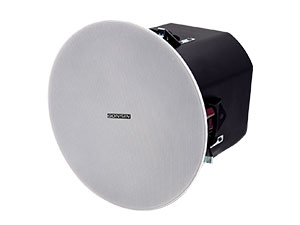
Within the first planning steps, you’ll see why the right [ceiling speaker] selection matters just as much as speaker count—especially in 70V/100V audio systems.
Key Factor #1: Understanding Ceiling Height and Dispersion
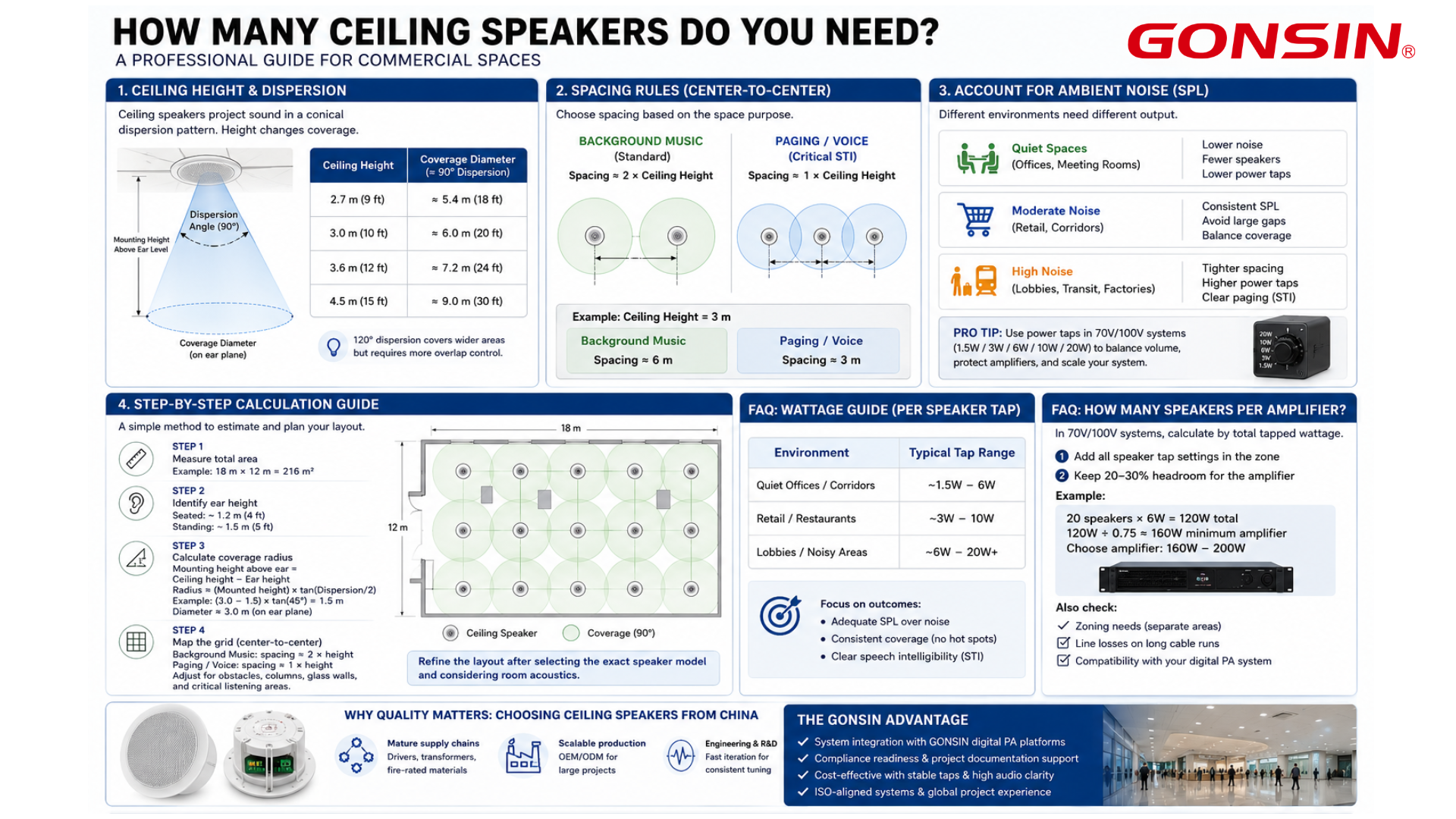
Most commercial ceiling speaker designs behave like a “sound flashlight”: they project audio in a conical dispersion pattern. The cone’s dispersion angle (commonly 90° to 120°) determines the speaker’s acoustic footprint on the listening plane (usually ear height).
Why ceiling height changes everything
Higher ceilings: each speaker covers a larger diameter, so you can use fewer speakers—but you typically need higher wattage taps and careful SPL planning to overcome distance and ambient noise.
Lower ceilings: you’ll often need more speakers, spaced closer, to avoid “hot spots” (too loud directly under the speaker) and “holes” (quiet areas between speakers).
Coverage increases with mounting height (quick reference)
Below is a practical, easy-to-use reference for coverage diameter on the floor assuming ~90° dispersion (common for paging-focused designs). Real products vary by frequency response and baffle design, but this is useful for early planning:
Ceiling height 2.7 m (9 ft): coverage diameter ≈ 5.4 m (18 ft)
Ceiling height 3. m (10 ft): coverage diameter ≈ 6. m (20 ft)
Ceiling height 3.6 m (12 ft): coverage diameter ≈ 7.2 m (24 ft)
Ceiling height 4.5 m (15 ft): coverage diameter ≈ 9. m (30 ft)
If your speaker is closer to 120° dispersion, coverage becomes wider—useful for background music—but you’ll usually need more overlap control to maintain consistent intelligibility (STI) for voice.
The “Rule of Thumb” for Professional Spacing (and why it works)
There are three common ways installers describe spacing:
1) Edge-to-Edge (minimal overlap)
Speakers are placed so coverage circles just touch.
Efficient on quantity, but risky for voice because intelligibility drops at the edges.
2) Minimum Overlap (recommended for most commercial sites)
3) Center-to-Center (how spacing is usually measured on plans)
How far apart should ceiling speakers be?
Use these spacing rules as a starting point (center-to-center):
Standard background music:
Spacing ≈ 2 × ceiling height
(Good balance of cost and evenness)
Critical paging / voice (high intelligibility STI):
Spacing ≈ 1 × ceiling height
(More speakers, clearer paging, fewer “dead zones”)
Example: If ceiling height is 3 m, then:
These are intentionally simple rules—your final grid should still consider dispersion angle, ambient noise, and the actual listening plane.
Account for Ambient Noise Levels (SPL and real-world performance)
A quiet boardroom and a busy hotel lobby may have the same square footage—but they do not need the same output. In noisy environments, your design must maintain adequate Sound Pressure Level (SPL) and preserve speech intelligibility (STI) over background noise.
Practical guidance by space type
Quiet spaces (meeting rooms, galleries): fewer speakers can work, but aim for smooth coverage at low volume.
Moderate noise (retail, corridors): prioritize consistent SPL; avoid large gaps.
High noise (lobbies, transit areas, factories): you may need tighter spacing, higher power taps, and sometimes zoning with more speakers to keep paging clear.
Pro tip: Use power taps in 70V/100V audio systems
In 70V/100V audio systems, ceiling speakers typically include a transformer with selectable transformer taps (e.g., 1.5W/3W/6W/10W/20W). This is essential for:
High-quality ceiling speakers from China frequently provide stable transformer performance and consistent tap ratings when sourced from reputable manufacturers with strong QC—an area where GONSIN’s engineering and project experience matters.
Step-by-Step Calculation Guide (simple, professional planning method)
You can estimate speaker quantity with a repeatable process—then refine it after you select the exact model.
Step 1: Measure total area (square footage or square meters)
Example: a lobby is 18 m × 12 m = 216 m².
Step 2: Identify the listener’s ear height
Typical ear height:
seated: ~1.2 m (4 ft)
standing: ~1.5 m (5 ft)
Why it matters: the “listening plane” isn’t always the floor. Designing to ear height helps reduce harsh hot spots and improves perceived uniformity.
Step 3: Calculate coverage radius using dispersion angle
A workable approximation for the coverage radius on the listening plane:
Example (quick math):
Ceiling = 3. m, ear height = 1.5 m → mounting height above ear = 1.5 m
Dispersion = 90° → tan(45°)=1
Coverage radius ≈ 1.5 m → coverage diameter ≈ 3. m (on ear plane)
This is why paging layouts often use tighter spacing than “floor circle” estimates: voice intelligibility depends heavily on what happens at ear height.
Step 4: Map the grid (center-to-center spacing)
Choose spacing based on purpose:
Then estimate count:
Speakers per row ≈ room length ÷ spacing
Number of rows ≈ room width ÷ spacing
Total ≈ (speakers per row) × (rows), rounded up
Refine after mapping: adjust for columns, alcoves, open counters, glass walls (reflections), and where paging clarity is most critical.
FAQ: How many watts should a commercial ceiling speaker be?
There’s no single “correct” wattage. In most commercial 70V/100V installations, the key is choosing the right tap setting per speaker based on distance, ambient noise, and desired SPL.
Typical starting points (per speaker):
Quiet offices / corridors: ~1.5W–6W
Retail / restaurants: ~3W–10W
Lobbies / noisy areas: ~6W–20W (sometimes higher depending on ceiling height and noise)
Focus on outcomes:
FAQ: How many speakers can I connect to one amplifier?
In a 70V/100V system, you calculate by total tapped wattage:
Add all speaker tap settings in the zone
Keep headroom (commonly 20–30%) so the amplifier isn’t running at its limit
Example:
Also check:
zoning needs (separate areas often require separate channels)
line losses on long cable runs
compatibility with your digital PA system controller and supervision requirements
Why Quality Matters: Sourcing a Ceiling Speaker from China (the strategic view)
Once you know how many speakers you need, the next question is which speakers will perform consistently across hundreds of units and years of operation.
Choosing professional ceiling speakers from China can be a smart move for international buyers when the manufacturer offers real engineering depth—not just low cost. China’s manufacturing hub matters because it can support:
mature supply chains for drivers, transformers, fire-rated materials
scalable OEM/ODM production for bulk projects
faster iteration between R&D and production for consistent tuning
The GONSIN advantage for commercial deployments
When sourcing through GONSIN, buyers benefit from a ceiling speaker ecosystem designed to work as part of a complete GONSIN digital PA architecture:
System integration: predictable performance with digital paging, zoning, and control platforms
Compliance readiness: support for international safety expectations and project documentation (varies by model and region requirements)
Cost-effectiveness without sacrificing clarity: stable transformer taps, balanced frequency response, and consistent QC for large orders
Trust signals: GONSIN’s ISO-aligned management systems and a global project portfolio across mission-critical venues
In commercial audio installation, consistency is a feature. A speaker that measures and sounds “close enough” in small batches can become a problem at scale—especially when intelligibility and zone balancing matter.
Conclusion: Don’t Guess, Plan
The right number of ceiling speakers is the result of ceiling height + dispersion angle + space purpose + ambient noise, mapped into a layout that delivers even SPL and strong intelligibility (STI). Good planning prevents dead zones, avoids waste, and improves the day-to-day user experience.
Ready to design your system? Explore GONSIN’s range of professional ceiling speakers or contact GONSIN engineers for a custom layout consultation tailored to your room dimensions, noise conditions, and 70V/100V zoning plan.



 اللغة العربية
  Español
  Français
  Pусский
  简体中文
简体中文 
.webp "FS-FHSS Wireless Simultaneous Interpretation System")
.webp "IR Simultaneous Interpretation System")
.webp "Interpreter Console")