If you’ve ever mixed or managed sound for a high-stakes event, you know the nightmare scenario: the front rows are overwhelmed, the middle seats are “okay,” and the back of the room can’t make out a single word. That “ghost” in the room is an audio dead zone—and in large venues, it’s rarely fixed by “turning it up.”
Dead zones are typically caused by a mix of phase interference (wave interactions that cancel each other out), inverse square law losses (level drops over distance), and real-world obstacles that create an acoustic shadow (pillars, balconies, deep overhangs, or even audience geometry).
The proven professional standard for consistent, intelligible coverage is the line array—but only when you pair high-quality hardware with correct deployment (aiming, hang height, and acoustic prediction). That’s where experienced AV integration meets the right product choice.
Why Traditional Speakers Fail in Large Venues
1) Point-source behavior creates hot spots and drop-offs
Most conventional loudspeakers behave like point sources: energy spreads outward in a widening sphere. In a large room, that means dramatic level differences between people close to the speaker and those far away.
2) The inverse square law works against you
In a typical point-source scenario, sound pressure level drops by about 6 dB every time distance doubles. So the coverage you “fix” in the back often becomes punishingly loud in the front—and intelligibility still suffers due to reflections.
3) Dispersion limitations leave seats uncovered
Wide rooms and multi-section seating layouts expose the weaknesses of narrow or inconsistent dispersion. If the horizontal pattern doesn’t match the seating geometry, you get “dark spots” where vocals lose clarity—especially where reflections dominate direct sound.
The Science of the Line Array: How It Erases Dead Zones
Cylindrical wavefront behavior (why coverage feels more even)
A properly designed line array approximates a cylindrical wavefront, which—over much of its useful range—can lose closer to 3 dB per doubling of distance (instead of 6 dB). In plain terms: the back rows stop sounding “starved” compared to the front.
Precise vertical control (aim energy at people, not ceilings)
Line arrays shine because you can control the vertical pattern by splaying (angling) cabinets to “paint” the seating area. That helps you:
Reduce energy wasted on ceilings (which drives reverb and muddiness)
Avoid blasting empty floors near the stage
Improve vocal intelligibility throughout the coverage zone
Wide horizontal coverage (cover the venue’s width cleanly)
In wide seating areas, you typically need broad, consistent horizontal dispersion (often in the 100°–120° class depending on the model and venue geometry). The goal is predictable coverage without “beaming,” harsh off-axis tone changes, or gaps across sections.
Choosing the Right Hardware: Why the Dual 10-Inch Configuration?
The “sweet spot” between punch, clarity, and controllability
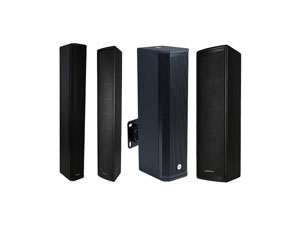
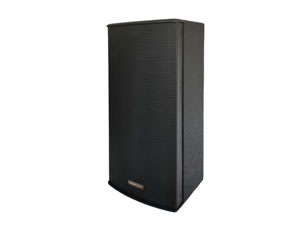
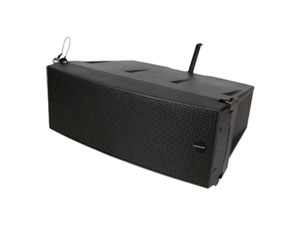
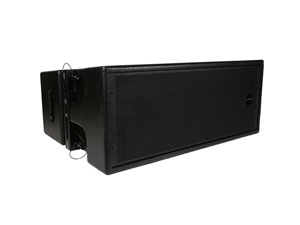
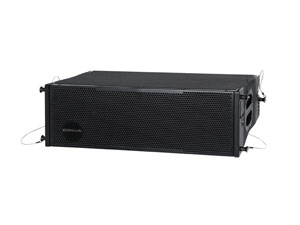
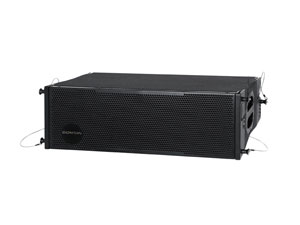
Dual 10-inch line array cabinets are popular because they balance:
Impact and headroom (more authority than many 8-inch designs)
Speed and clarity (often cleaner transient response than heavier 12-inch approaches)
Practical considerations like cabinet size/weight, which matters for rigging and transport
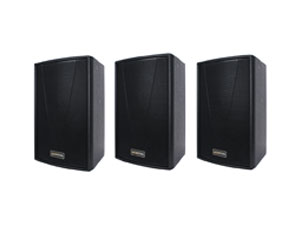
When looking for a high-performance line array speaker for sale, savvy integrators prioritize the balance of SPL and cabinet weight found in dual 10-inch models.
Technical deep dive: What to look for in the spec sheet (and why it matters)
For demanding venues—stadiums, houses of worship, arenas, and touring systems—key specs and design choices often include:
Premium driver and component quality for consistent tonality and reliability (including HF/LF component selection and robust engineering)
High maximum SPL for real-world headroom in loud environments (the GONSIN Dual 10-inch Line Array Series highlights up to 135 dB Max SPL)
Sensitivity (e.g., 103 dB/1W/1M) to help achieve required level with amplifier efficiency
Crossover frequency design that supports smooth vocal transition and reduces harshness
Waveguide technology to stabilize dispersion and maintain off-axis clarity
Pro Installation Tips: 3 Ways to Ensure Total Coverage
Tip 1: Calculate your hang height (and aim for the last row first)
Hang height isn’t just “what looks right.” It determines sightline clearance, throw distance, and vertical coverage. A system tuned for the front rows often fails the back rows—so aim and design around your farthest listeners, then manage the near-field with splay angles and level strategy.
Tip 2: Use acoustic simulation before you fly the first cabinet
Modern prediction tools help you identify dead zones, overlap areas, and potential phase issues early—before rigging time and labor costs pile up. Simulation is also where you can pre-empt issues like balcony under-coverage and acoustic shadow regions.
Tip 3: Don’t ignore cabinet build quality (it’s a sound quality factor)
Touring-grade construction isn’t only about durability. Stiff enclosures reduce unwanted vibration and coloration. For example, 18mm birch plywood designs are often favored because they help reduce cabinet resonance that can smear midrange detail (where speech intelligibility lives).
Technical Spotlight: Line Array vs. Point Source (At-a-Glance)
| Feature | Line Array (e.g., Dual 10-inch array element) | Traditional Point-Source Speaker |
|---|
| Distance behavior | More consistent perceived level (often closer to ~3 dB loss per doubling across useful range) | Typical ~6 dB loss per doubling of distance |
| Vertical control | Strong (via splay angles and array geometry) | Limited; often spills into ceiling/floor |
| Dead zone risk | Lower when designed/predicted correctly | Higher in long-throw or complex seating |
| Speech intelligibility potential | High, with correct aiming and tuning | Often inconsistent across seating zones |
| Deployment | Requires rigging + prediction discipline | Simpler, but less scalable for big rooms
|
Conclusion: Investing in Clarity (Not Just Volume)
Eliminating dead zones isn’t about making the system louder—it’s about designing coverage that stays consistent, intelligible, and controlled from front row to back row. That requires the right wave behavior, dispersion control, component quality, and deployment strategy.
If you’re evaluating a solution for a stadium, arena, house of worship, or large event space, explore the specs or request a quote for the GONSIN Dual 10-Inch Line Array Series here: line array speaker for sale.
FAQ
How many line array speakers do I need for a 1,000-seat venue?
It depends on room geometry, trim height, desired SPL, and intelligibility targets. As a starting point, many 1,000-seat rooms use two hangs (left/right) with enough modules per side to cover the vertical seating span—then finalize the module count through acoustic prediction and on-site verification.
What is the advantage of a dual 10-inch over a single 12-inch speaker?
Dual 10-inch designs often deliver a strong balance of punch and clarity, with fast transient response and practical cabinet form factor. In many applications, they provide scalable headroom while keeping vocal detail clean—especially when paired with well-designed waveguides and crossover tuning.
Can I use line array speakers for outdoor public address?
Yes. Line arrays are widely used outdoors because they can project evenly over distance and maintain intelligibility when configured properly. Wind, temperature gradients, and ambient noise matter outdoors, so prediction, aiming, and appropriate SPL headroom become even more important.



 اللغة العربية
  Español
  Français
  Pусский
  简体中文
简体中文 
.webp "FS-FHSS Wireless Simultaneous Interpretation System")
.webp "IR Simultaneous Interpretation System")
.webp "Interpreter Console")