```html
Introduction: The “Invisible Barrier” in Modern Meetings
You’ve probably lived this moment: a hybrid meeting is underway, a key stakeholder joins remotely, and suddenly the conversation becomes a guessing game. The person at the far end of the table sounds like they’re speaking through a wall. Meanwhile, the air conditioner hums steadily, laptops click, paper rustles, and side comments blur into a constant wash of noise.
This is more than an annoyance—it’s an equity problem.
What “meeting equity” actually means
Meeting equity isn’t just about having a seat at the table (or a tile on a screen). It’s the equal ability to:
And in 2024, achieving that equity depends heavily on what your conference room microphones can do beyond “making things louder.”
Thesis: A modern conference microphone system isn’t about raw volume—it’s about acoustic engineering and digital signal processing that protects speech and minimizes distractions so every voice lands with the same authority.
Why Background Noise Is the Enemy of Productivity
Listening fatigue: the hidden cost of “good enough” audio
When your brain must constantly separate speech from noise, it burns energy doing extra processing. This is often described as listening fatigue—the mental exhaustion that comes from strained comprehension.
Even small degradations in speech intelligibility add up:
The hybrid gap: why standard mics fail in real rooms
Many “basic” meeting setups rely on an omnidirectional pickup pattern—often a single center-table speakerphone or ceiling “puck” mic. In a large room, that approach tends to capture everything except clean speech:
HVAC rumble and air movement
Keyboard taps and chair noise
Crosstalk and side conversations
Reverberation from hard surfaces
The result is a poor Signal-to-Noise Ratio (SNR)—the voice isn’t sufficiently louder than the room. Remote participants end up as passive observers because it’s simply too hard to follow.
Expert insight: audio beats video for remote success
Across hybrid-work research and IT deployment experience, one theme is consistent: people will tolerate mediocre video, but they won’t tolerate unclear audio. Poor audio increases friction, reduces participation, and directly impacts outcomes.
The Digital Advantage: How GONSIN Technology Filters the Chaos
This is where a professional conference microphone system separates itself from general-purpose meeting audio. In a properly designed digital discussion environment, the goal is not “amplification.” The goal is intelligibility—clean, stable speech that survives real rooms and real behavior.
Directional audio pickup: controlling what the mic hears
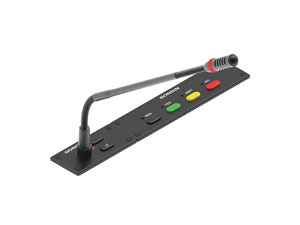
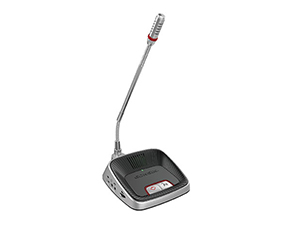
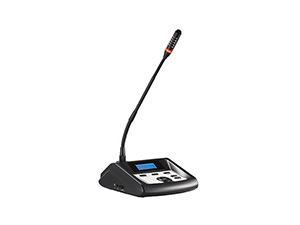
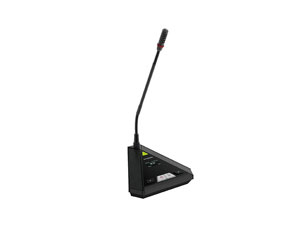
Dedicated gooseneck microphones with cardioid or hyper-cardioid pickup patterns are designed to focus on the talker and reject off-axis noise (like HVAC vents or side chatter). Compared to ceiling mics or center-table omnidirectional units, directional pickup:
Improves SNR at the source
Reduces room reverberation pickup
Helps remote listeners distinguish who is speaking
This is one of the fastest ways to raise perceived audio quality—because the system starts with cleaner input.
Digital Signal Processing (DSP): protecting speech early
Professional systems reduce interference by converting the voice signal into digital data early in the chain, enabling advanced DSP workflows like:
Noise reduction and filtering
Dynamic processing to stabilize speech clarity
Consistent routing and control across many microphones
In practical terms: the system has more tools to prioritize human speech and suppress “room chaos,” which improves Speech Intelligibility (STI) and reduces miscommunication.
Acoustic Echo Cancellation (AEC): preventing the hybrid “feedback loop”
In hybrid meetings, audio leaves the room (to remote attendees) and returns to the room (through speakers). Without effective Acoustic Echo Cancellation (AEC), you get:
Echo heard by remote participants
The classic “feedback loop”
People talking over each other because of delayed or repeated audio
AEC works by modeling the loudspeaker signal and subtracting it from the microphone input—so microphones capture voices, not the amplified return audio. When done well, it supports more natural conversation and can enable a more full-duplex audio experience (talking and listening simultaneously without collapse into echo or suppression).
Achieving Meeting Equity Through Structured Discussion
Noise control is the technical foundation—but meeting equity is the human outcome. A digital discussion system doesn’t just improve audio quality; it changes group dynamics so everyone can contribute.
The “Chairman” vs. “Delegate” dynamic: structure creates fairness
In many meetings, louder voices dominate—not because they’re more correct, but because they’re more audible and more persistent.
Discussion systems introduce structure through:
Dedicated chairman and delegate units
Speaking permissions or request-to-speak workflows
Clear active-speaker indication
That structure can prevent “floor hijacking,” encourage turn-taking, and ensure quieter participants aren’t drowned out—especially when remote stakeholders are involved.
Consistent audio levels: Automatic Gain Control (AGC)
People don’t speak at the same volume. Without leveling, remote participants hear a rollercoaster—whispers disappear, louder voices distort.
Automatic Gain Control (AGC) helps normalize speech levels so:
Soft speakers remain intelligible
Loud speakers don’t overwhelm the mix
Remote listeners experience consistent loudness and clarity
This is a direct contributor to meeting equity: every participant’s voice is delivered with comparable presence.
Case Study Scenario: The Boardroom Transformation
Before: one central speakerphone, remote users as “observers”
A typical setup might be a single center-table device handling:
In larger rooms, this often produces:
Distant, hollow voices due to reverberation
Side noise amplified equally with speech
Frequent interruptions: “Can you repeat that?”
Remote attendees stop contributing because it feels risky to interject when they can’t hear reliably.
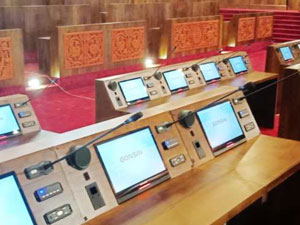
After: a GONSIN digital discussion system with dedicated units
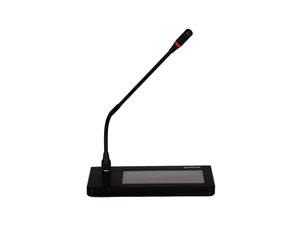
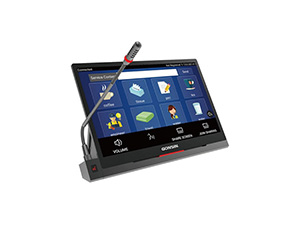
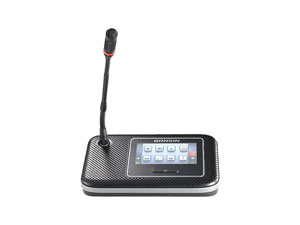
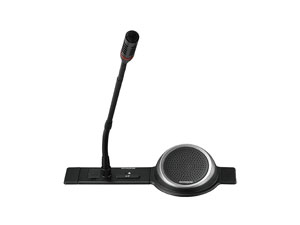
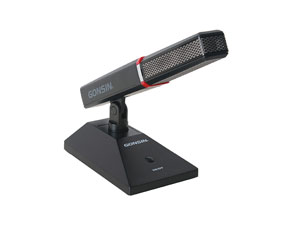
With a digital discussion system, each participant has a dedicated microphone unit, enabling:
Deployments commonly support clean cabling and expansion via daisy-chaining / loop-in-loop-out, keeping installation organized and scalable for larger tables or reconfigurable rooms.
Result: fewer repeats, faster decisions
In a realistic boardroom transformation, clearer speech and reduced confusion can cut meeting waste significantly—often seen as fewer interruptions and smoother alignment.
Outcome example: A 40% reduction in meeting time due to clearer communication and near-zero “can you repeat that?” moments—because the meeting stops paying the “audio tax.”
Conclusion: Investing in the Voice of Your Organization
Background noise isn’t just a technical nuisance—it’s a barrier to inclusion. If remote participants can’t consistently understand and be understood, hybrid becomes unequal by design.
When you upgrade your conference room microphones, you aren’t simply buying hardware. You’re investing in:
FAQs
How do I stop my conference room mic from picking up background noise?
Use directional microphones (cardioid/hyper-cardioid), reduce the mic-to-mouth distance (about 20–30 cm), and adopt a system with DSP features that improve SNR and speech-focused processing. Avoid relying on a single omnidirectional mic in large rooms.
What is the difference between a discussion system and a standard microphone?
A discussion system is a coordinated platform (units + control + audio processing) designed for multi-person meetings. It supports features like chairman/delegate control, structured turn-taking, consistent level management (e.g., AGC), and professional routing—whereas a standard microphone is usually just an input device without meeting workflow control.
Why is digital audio better than analog for large meetings?
Digital systems convert audio earlier and enable advanced processing and stable distribution across many microphones with less susceptibility to interference and noise accumulation. In large meetings, that improves speech intelligibility, simplifies management, and supports hybrid features like AEC more effectively.
```



 اللغة العربية
  Español
  Français
  Pусский
  简体中文
简体中文 
.webp "FS-FHSS Wireless Simultaneous Interpretation System")
.webp "IR Simultaneous Interpretation System")
.webp "Interpreter Console")